Glance - A swipe-first news companion that helps you verify a story in two taps

Product Strategy
UX Research Synthesis
Interaction Design
What is Glance?
Merging finance with the simplicity and agility of nature
Glance is a mobile-first news experience built for Gen Z and Millennial readers who discover stories through fragmented feeds, but hesitate to trust or share without receipts. The product reframes “news verification” as a fast, repeatable flow: move from headline to claim, then reveal Source, Consensus, and Evidence in a way that is clear, lightweight, and discussion-safe.
Role
Product Designer (end to end)
Duration
2 Weeks
Tools
Figma, FigJam, Notion
Project Type
B2B B2C
Project Overview & Problem Statement
Modern news consumption is fast, social, and fragmented.
People see a headline in TikTok, Instagram, Reddit, or X, then do one of two things:
Share it immediately (and regret it later), or
Open multiple tabs to verify (and drop off because it takes too long).
In parallel, most “discussion” happens in public threads, where the incentive is performance, not truth-seeking. Verification becomes exhausting, and trust erodes further.
Design constraint: the smallest useful unit of truth is a claim, not a headline. Product constraint: discussion should not contaminate facts. Finite beats infinite.
Audience
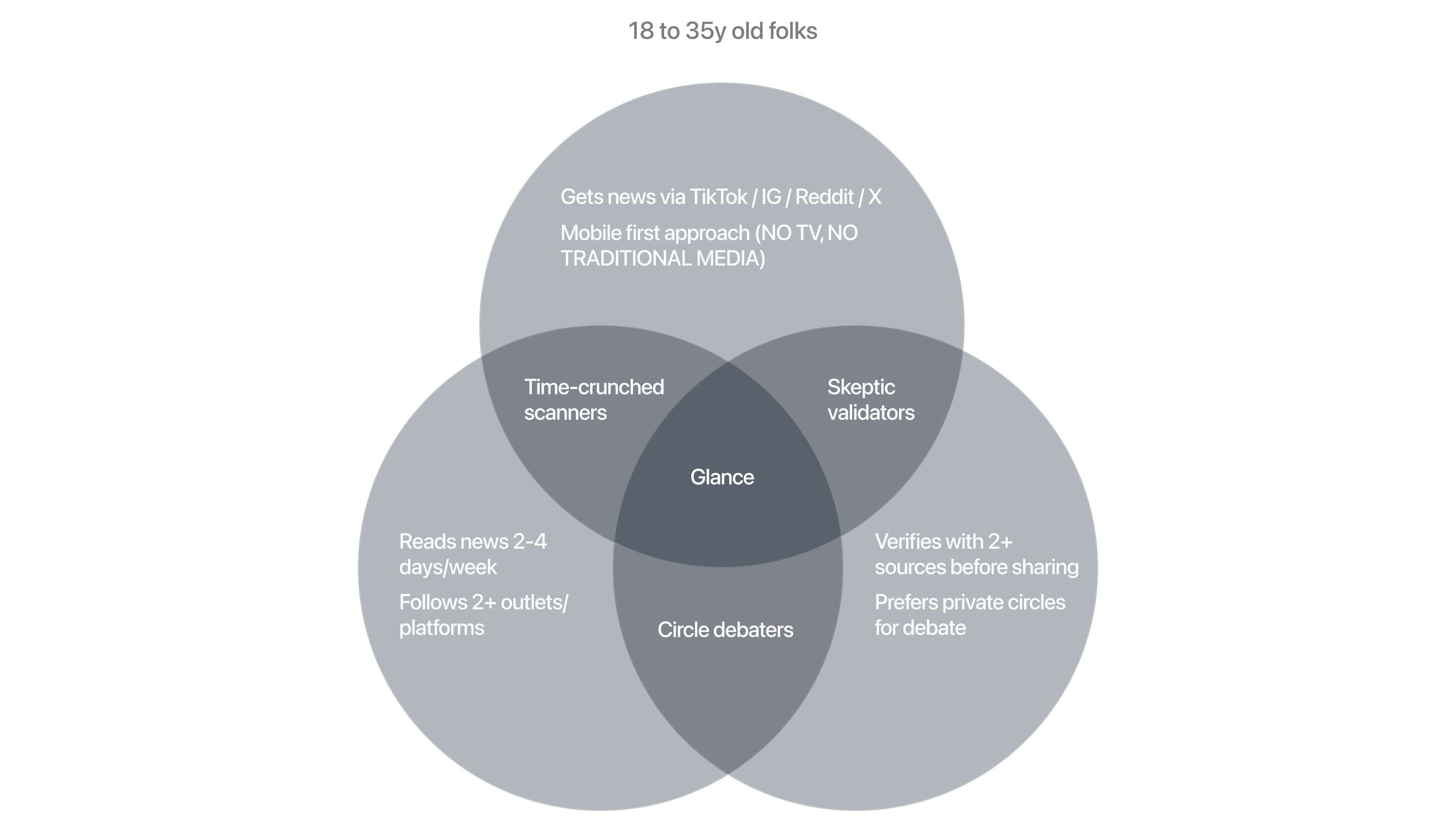
Glance was designed for 18 to 35 year olds who are mobile-first and politically mixed, and who read news at least 2 to 4 days per week while sharing in chats weekly.
What I learned
I started with a simple observation: trust is not built by reading more. Trust is built by seeing receipts quickly, in a format that feels neutral and repeatable.
UX Lense
Jobs to be done:
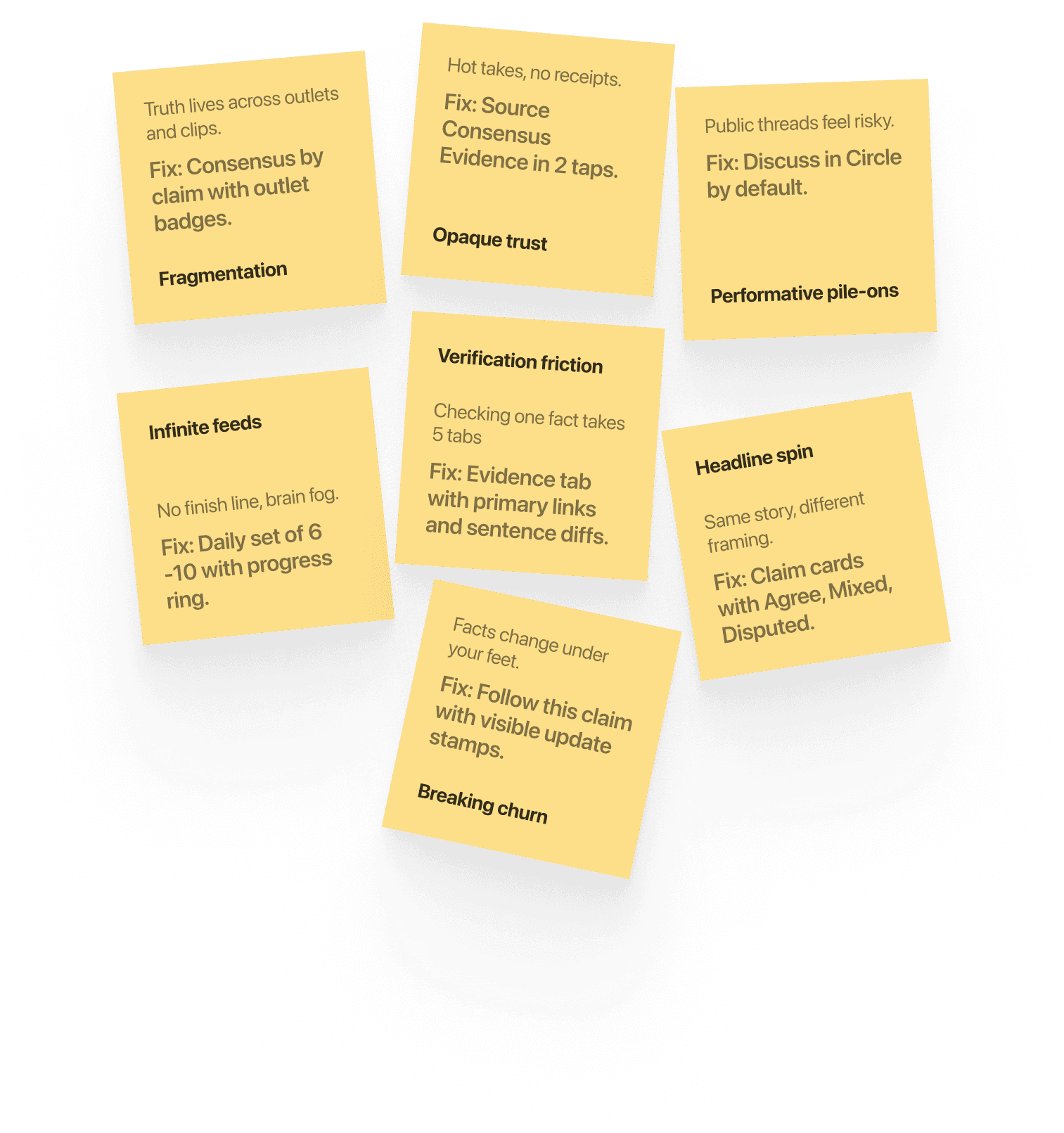
Let's Brainstorm!
Ask yourself some questions..
User Pain Points

“I see a headline or a clip, and I have no idea what’s real. Verifying it takes too long, so I either drop it or share it and hope I’m not wrong.”
User Expectations
Through interviews and quick concept tests, I mapped what Gen Z and Millennial readers expect from a trust-first news experience. Users want a fast way to validate a story before they share it, without opening multiple tabs. They expect clear receipts, simple language, and a lightweight path to compare how different outlets frame the same claim.
Turns out, many users trust creators, Reddit threads, and group chats more than publisher branding or “official” headlines.
Most people rely on friends for verification because the current tools feel heavy, unclear, and too time-consuming.
Fragmented Information Ecosystem
“I have to check 3 different sources just to understand what actually happened.”
Verification Friction
“By the time I open two tabs and skim, I’ve already lost interest.”
Information Overload Without Context
“I’m shown opinions, hot takes, and endless posts, but no clear evidence or what matters.”
No Clear Path to Confident Sharing
“I want to share, but I need something I can point to, not just vibes.”
Empathy Map
Sees. Thinks. Does. Feels.
Sees
screenshots, short clips, partial quotes, headlines that do not match the article body
Thinks
“Is this real or framed to win clicks?” “What did other outlets actually say?”
Does
skims a summary, taps through to verify, saves a link, shares to a small group
Feels
overwhelmed by volume, cautious about being wrong in front of friends
The design strategy
I treated “verification” as a product surface, not a separate workflow.
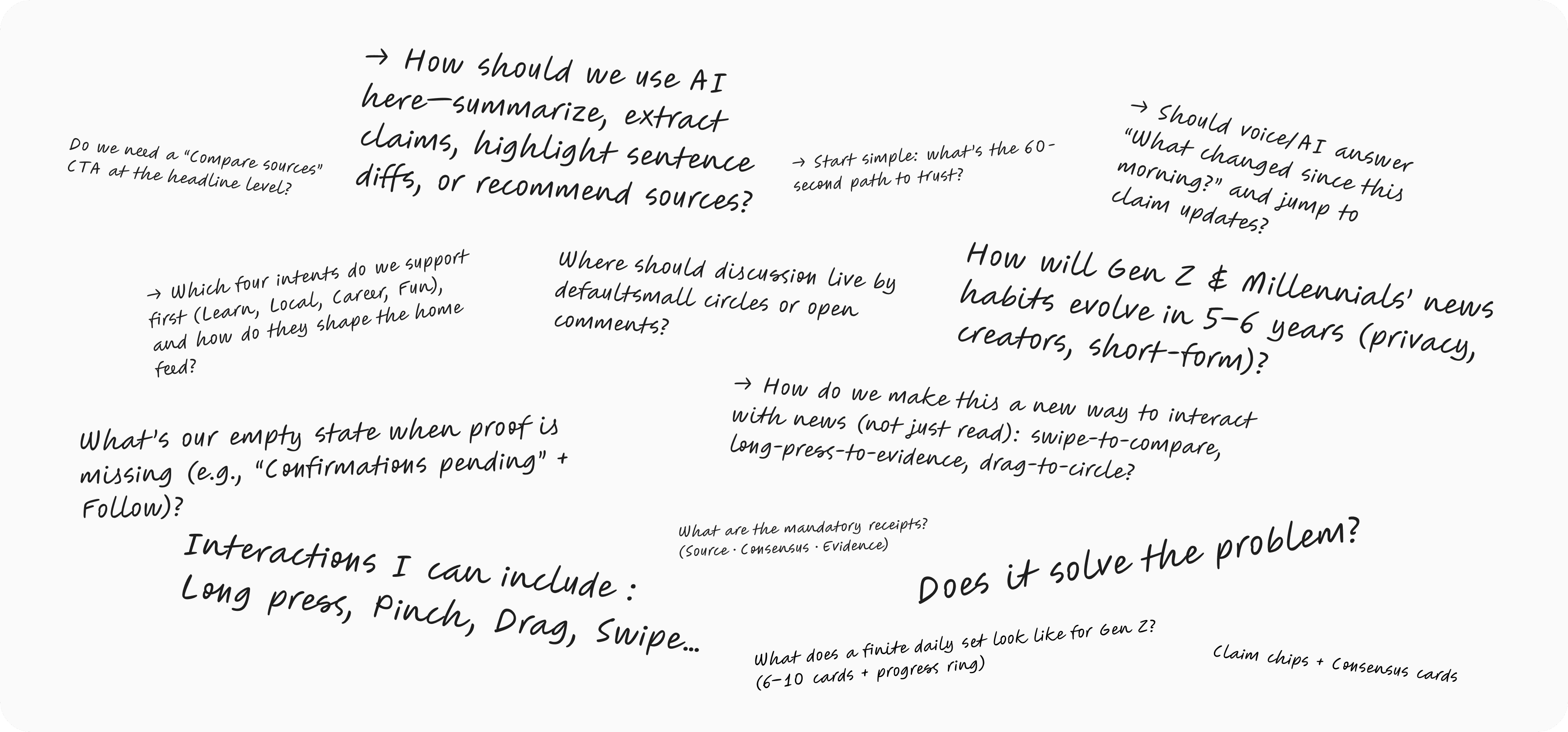
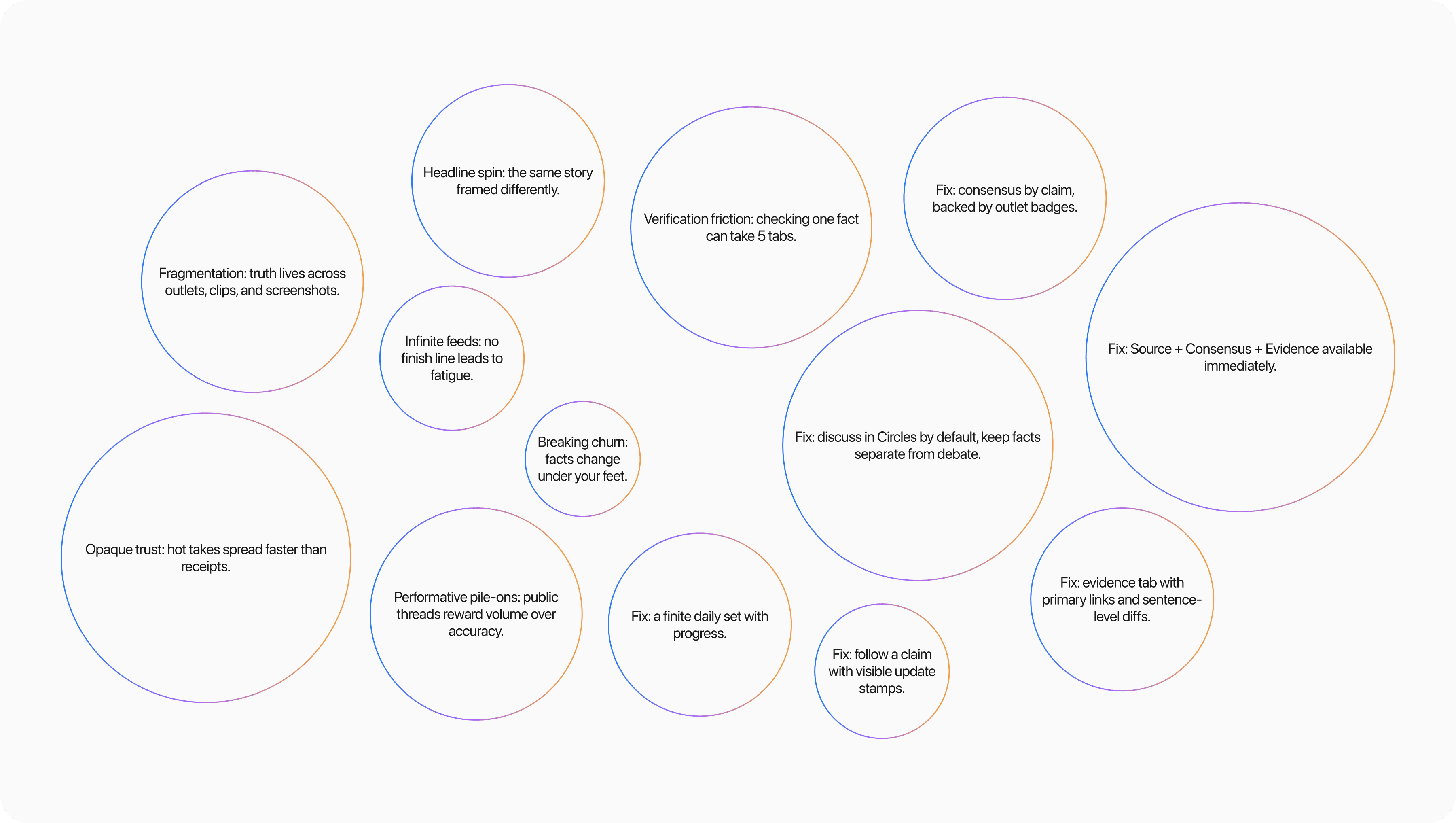
The problems & fixes I explicitly designed for
User groups with UX implications
Primary Users
Time-Crunched Updaters
Circle Debaters
Creators & Explainers
Skeptic Validators
Local-First Seekers
Secondary Users
News-Lite Lurkers
Issue Trackers
Event-Driven Spikes
Accessibility-First Readers

User Persons
Based on the interview insights
Meet Alex!
Background
Jordan is a 30-year-old product manager who follows news daily and frequently debates topics with friends in smaller circles.
He values accuracy and tries to verify before sharing, but he is frustrated by how inefficient verification is today.
Behaviour & Goals
Often opens 2 to 4 sources before forming an opinion.
Wants to quickly identify what is agreed upon vs disputed across outlets.
Uses news to make sense of the world, not to “win” arguments, and prefers evidence-led discussion.
Pain Points
Current news apps optimize for engagement, not clarity, and bury the verification path.
Hard to track claim updates over time, especially when stories evolve quickly.
Public discussions turn into noise and do not anchor to receipts.
Tech Savviness
Very comfortable with technology and expects high-quality information design.
Will use AI when it is explainable and routes back to sources, not when it produces confident summaries without evidence.
Expectations from Glance
A claim-first breakdown that makes the smallest unit of truth checkable.
A structured Consensus layer (Agreed, Mixed, Disputed) to reduce debate confusion.
Evidence that feels like receipts, with primary links and highlighted passages.

Meet Maya!
Background
Maya is a 24-year-old early-career professional who gets most of her news from TikTok, Instagram, Reddit, and group chats.
She cares about staying informed, but she does not trust headlines and hates the feeling of being manipulated by framing.
Behaviour & Goals
Skims news in short bursts between work, commute, and downtime.
Wants a fast way to understand what happened, without opening multiple tabs.
Shares stories in private chats and wants to avoid being the person who spreads something misleading.
Pain Points
Verification takes too long, so she either drops the story or shares without confidence.
Feels overwhelmed by volume and struggles to separate facts from opinions and hot takes.
Finds public comment threads performative and not useful for getting to the truth.
Tech Savviness
Comfortable with modern apps and AI features, but only when they are transparent and skimmable.
Prefers “tap to verify” patterns over deep menus and dense dashboards.
Expectations from Glance
A swipe-first feed that is finite, easy to complete, and not designed for doomscrolling.
“Two taps to receipts” with clear Source, Consensus, and Evidence for any story.
A clean way to compare how different outlets state the same claim.
User Journey
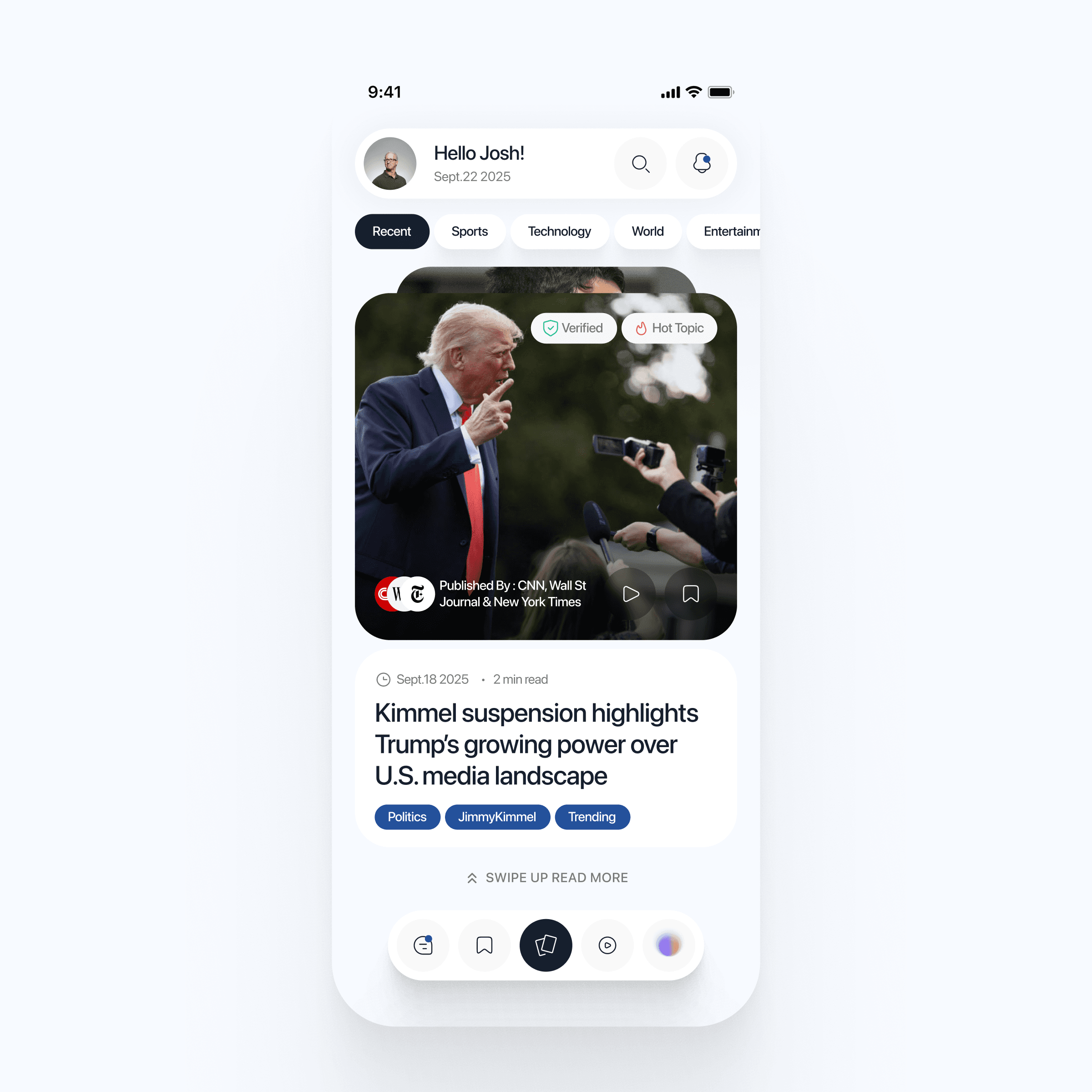
Key experience 1: The Home Screen (finite and swipe-first)
The home feed is intentionally lightweight. It is designed to reduce doomscrolling and get users to a decision.
The Home Screen
We have three things to show
A new, swipe-first way to read
Swipe up to read. Swipe right to skip.
Source. Consensus. Evidence
Receipts on every card for maximum relevance.
Connect & discover together
Save it. Discuss on open floor. Find more like it.
Key experience 2: The Story view (from headline to checkable claims)
The story view is where Glance shifts the mental model: you are not reading a “story,” you are validating a set of claims.
AI Summary
A fast read that reduces effort, not accountability.
Key Points
Scannable bullets that map to claims.
Compare
A structured way to see how outlets present the same facts.
Highlights
Sentence-level emphasis so users can spot framing quickly.
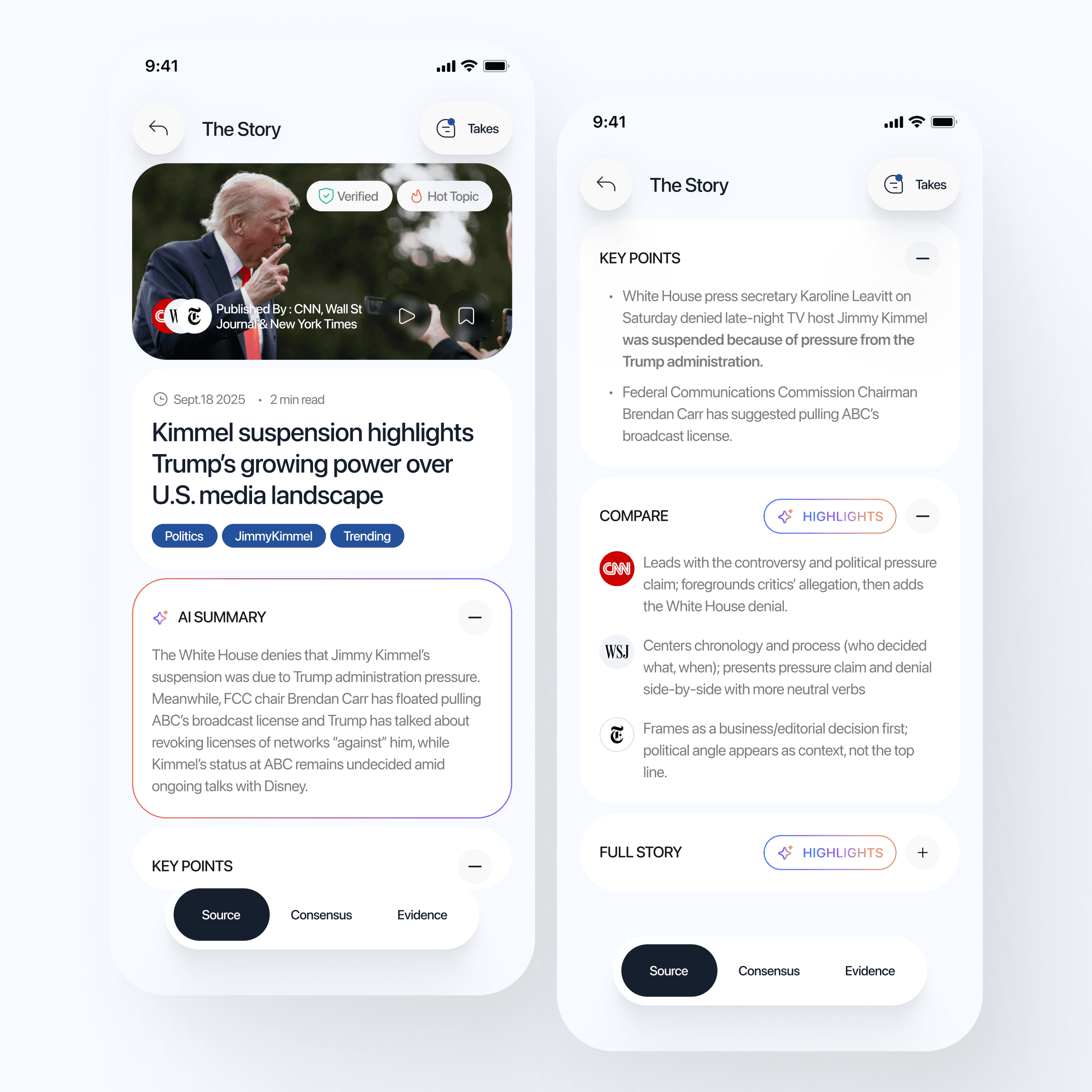
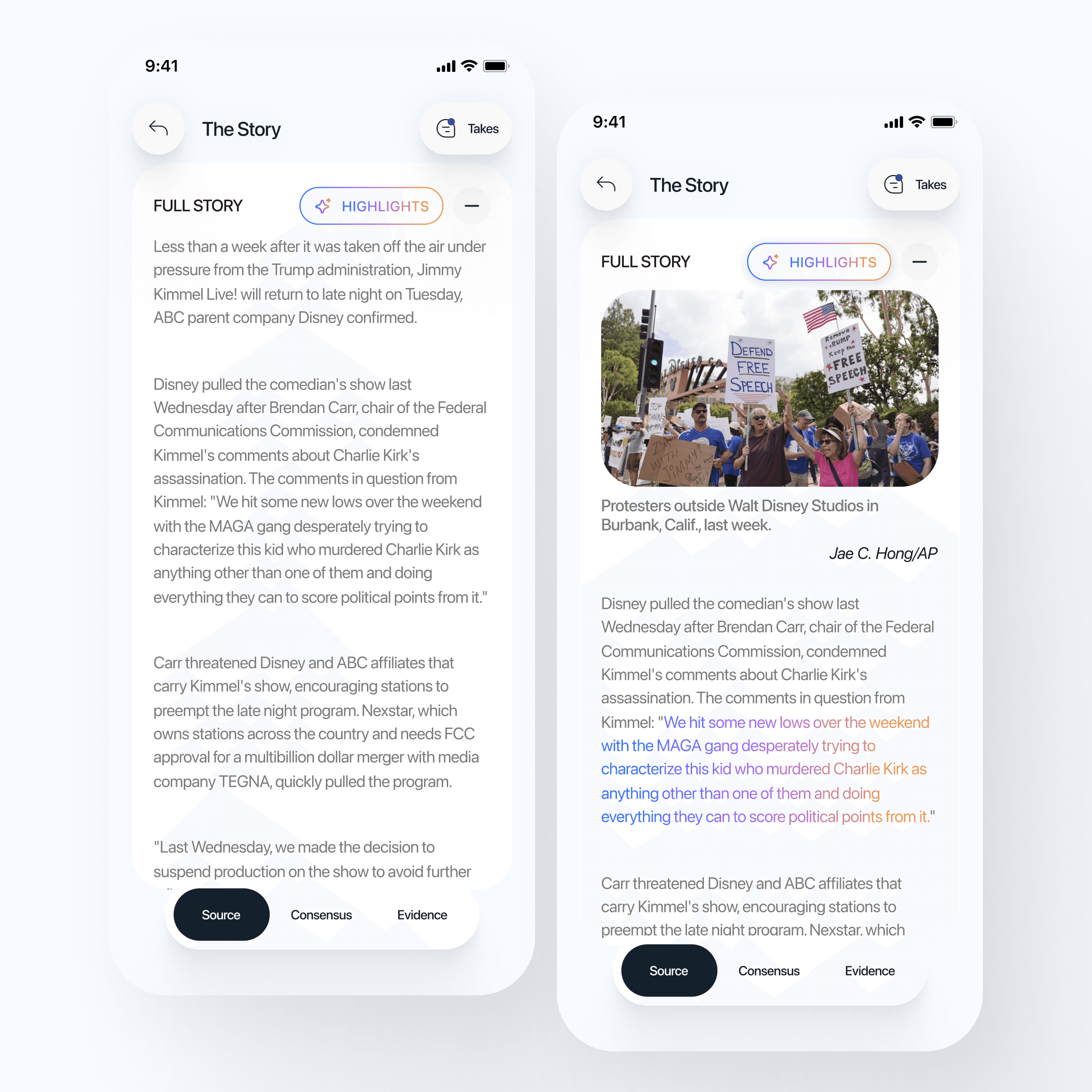
Design intent: the user should always know what to do next, and they should never feel trapped in a long article.
This is the centerpiece of Glance’s differentiation.
Key experience 3: Consensus as claim cards (Agreed, Mixed, Disputed)
Instead of arguing about entire articles, Glance breaks a story into discrete claims, then shows how those claims land across sources:
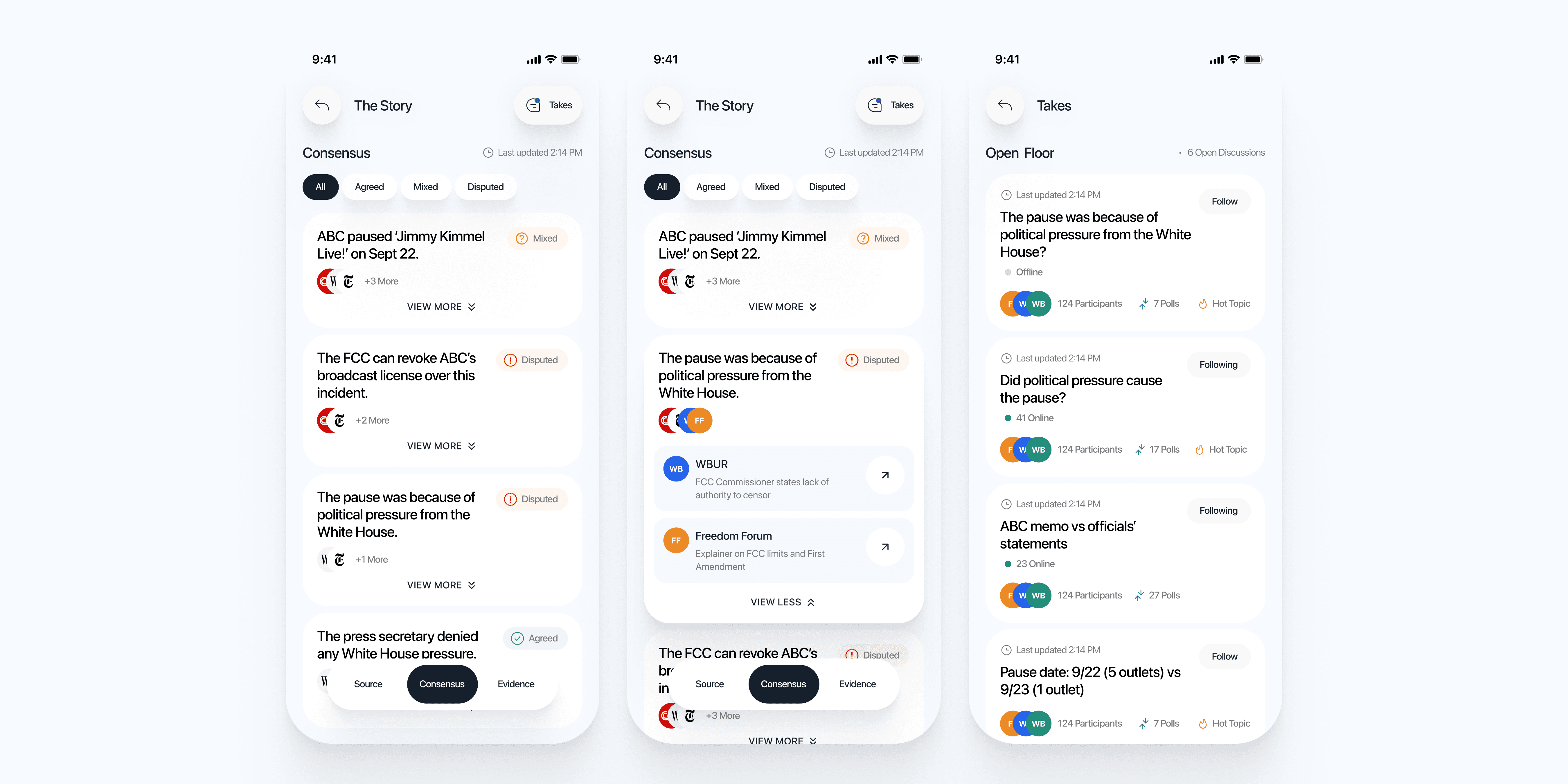
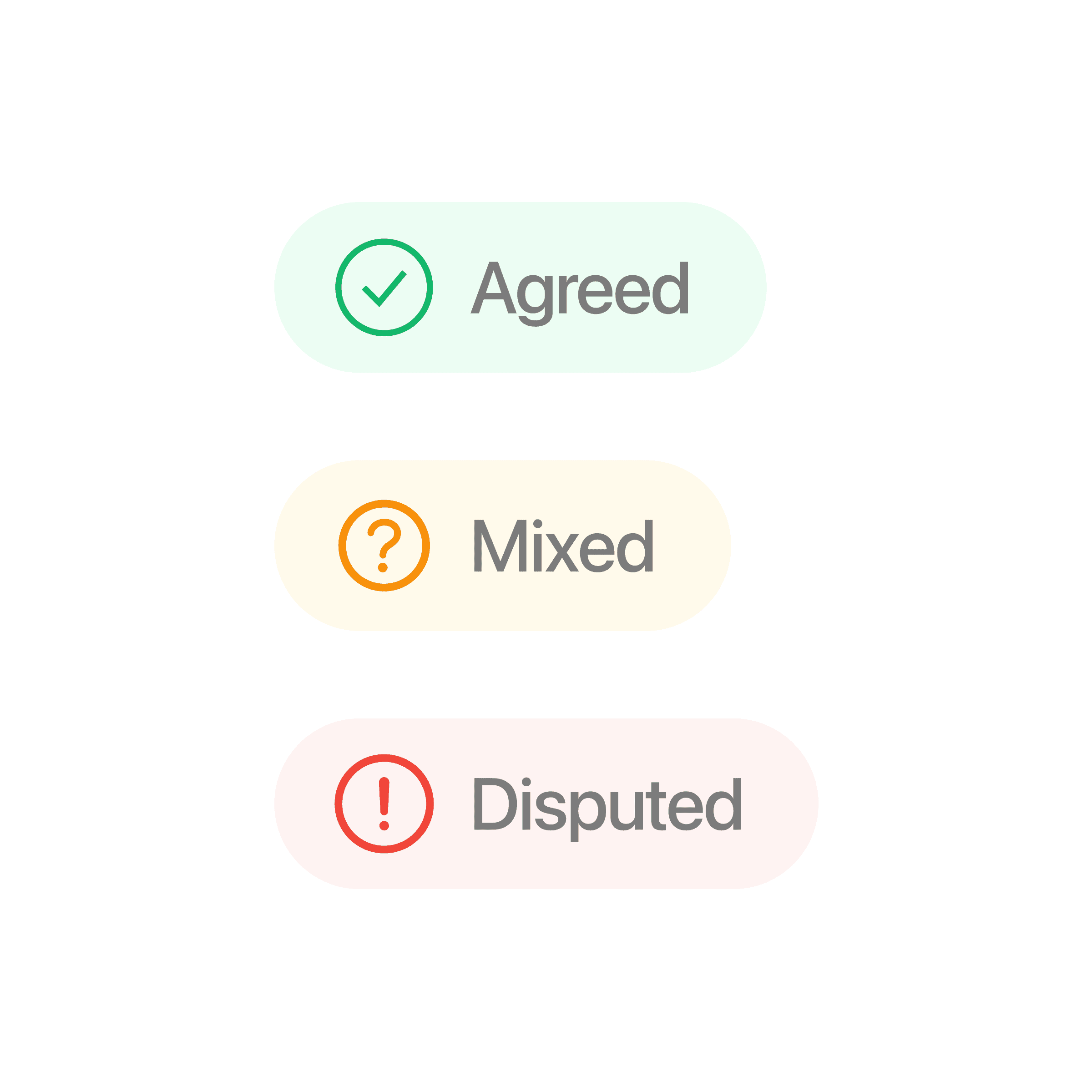
Agreed
Most outlets support the claim similarly.
Mixed
The claim is partially supported or framed inconsistently.
Disputed
Outlets contradict the claim, or evidence is weak.
Why this matters: users often cannot explain why they distrust something. Claim cards give them a neutral structure to think and talk.
Key experience 4: Discussion, without contaminating facts
Glance separates facts from debate intentionally.
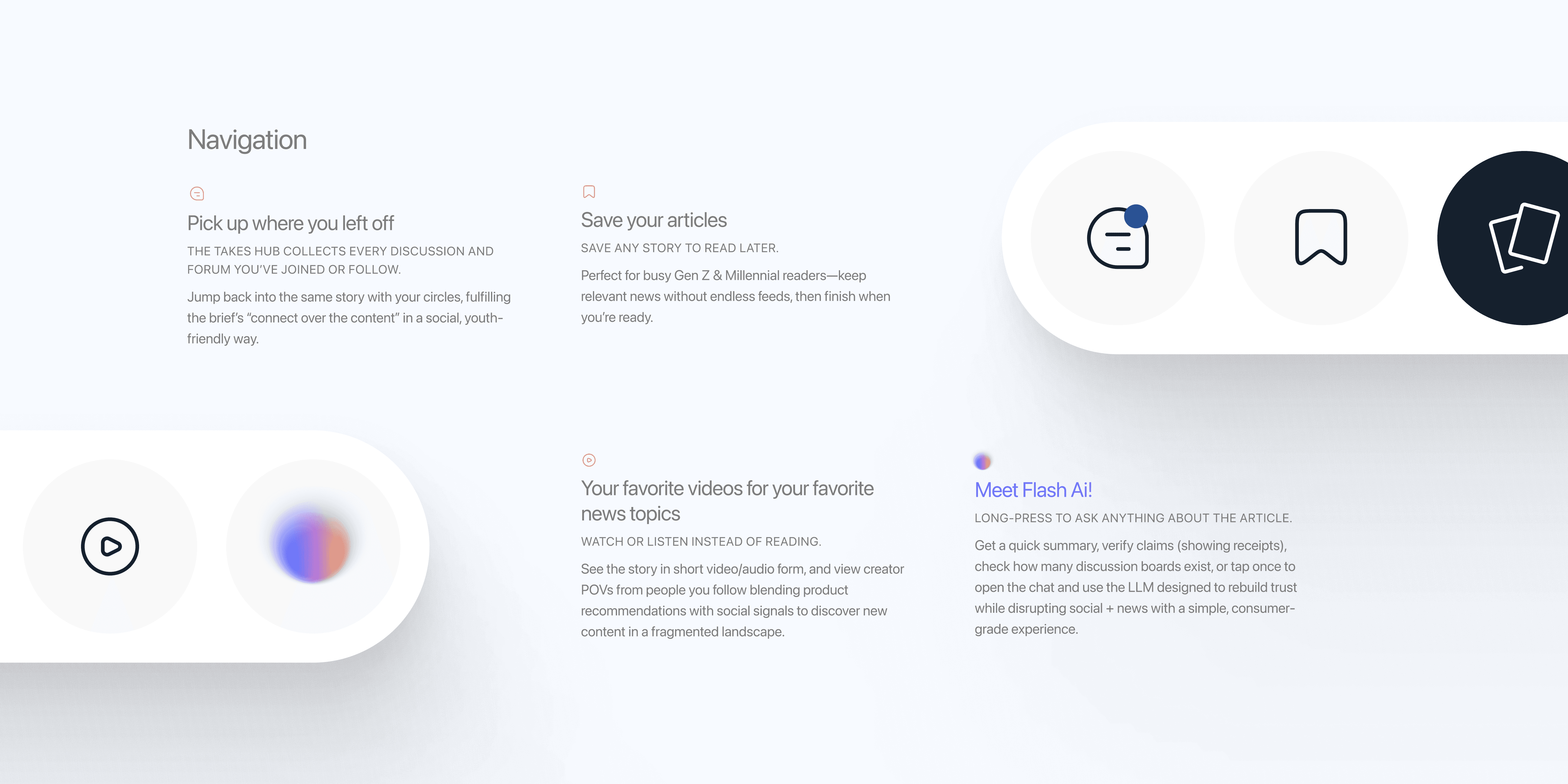
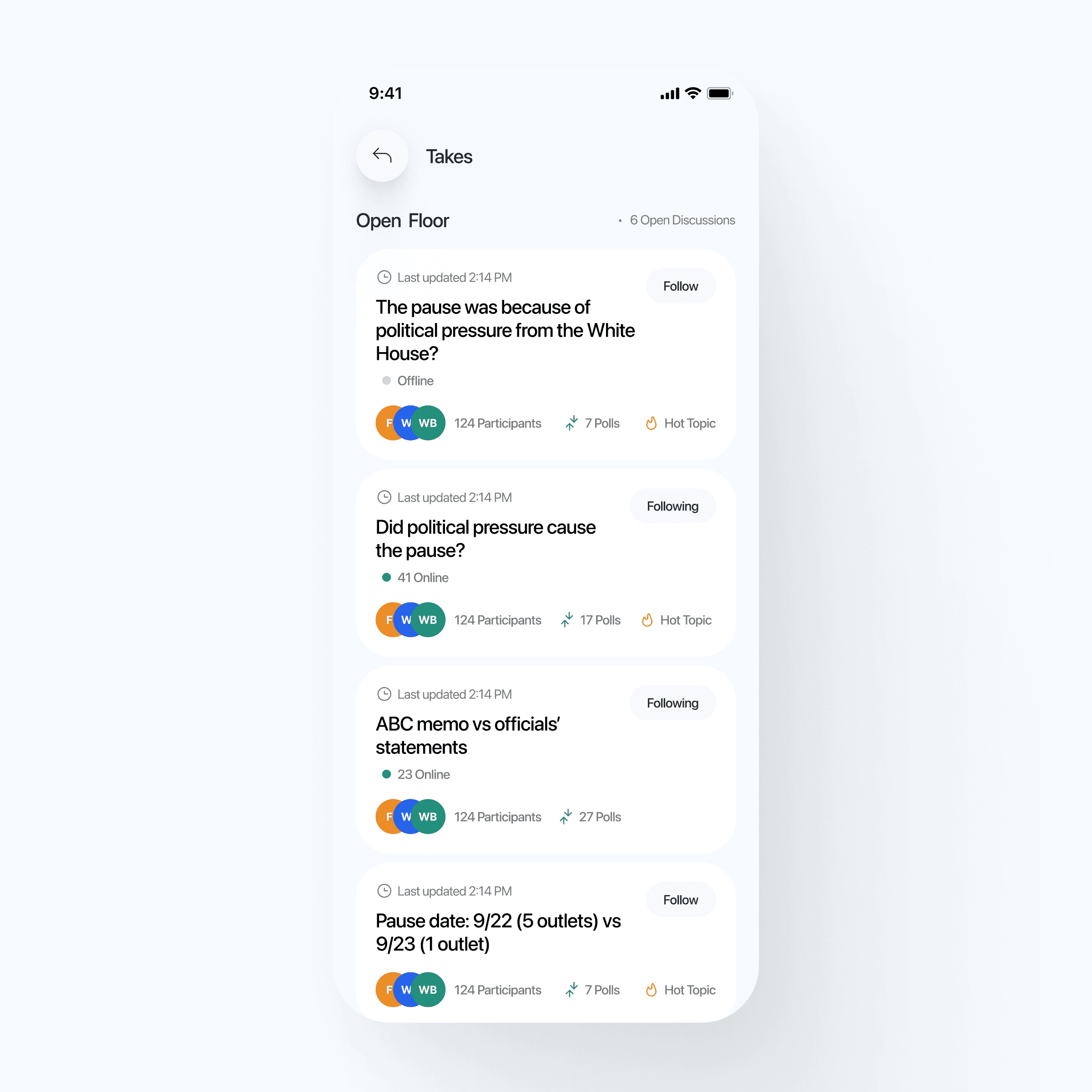
Takes Hub
Glance organizes discussion as a parallel layer:
Pick up where you left off across stories and forums you follow.
Save stories to return when you have time.
Join circles for small-group debate, or open threads when public input is valuable.
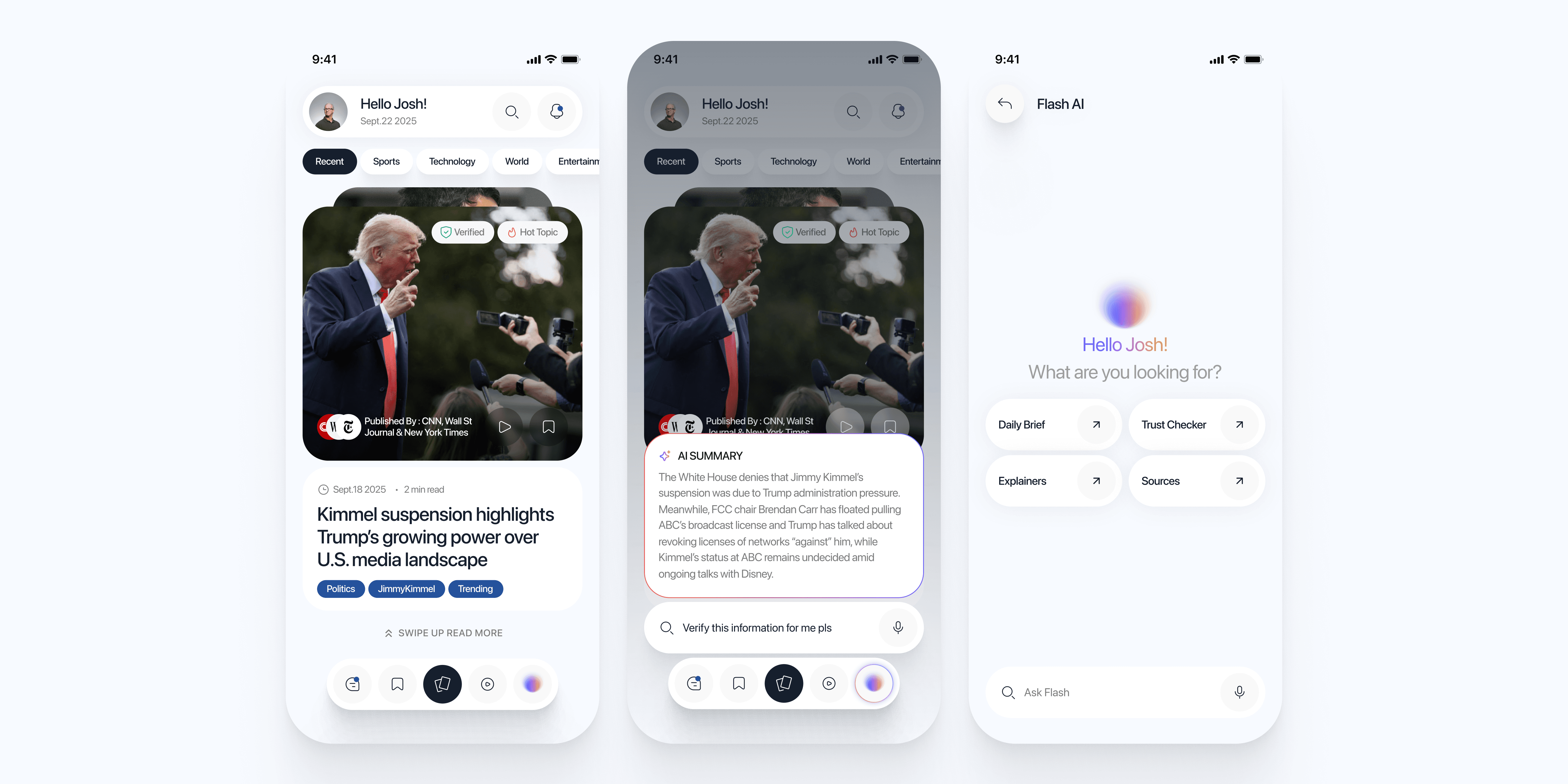
Meet Flash!
Flash AI: the assistant designed for verification, not vibes
Flash AI reduces effort, but it does not replace verification. Every answer routes back to Source, Consensus, and Evidence.
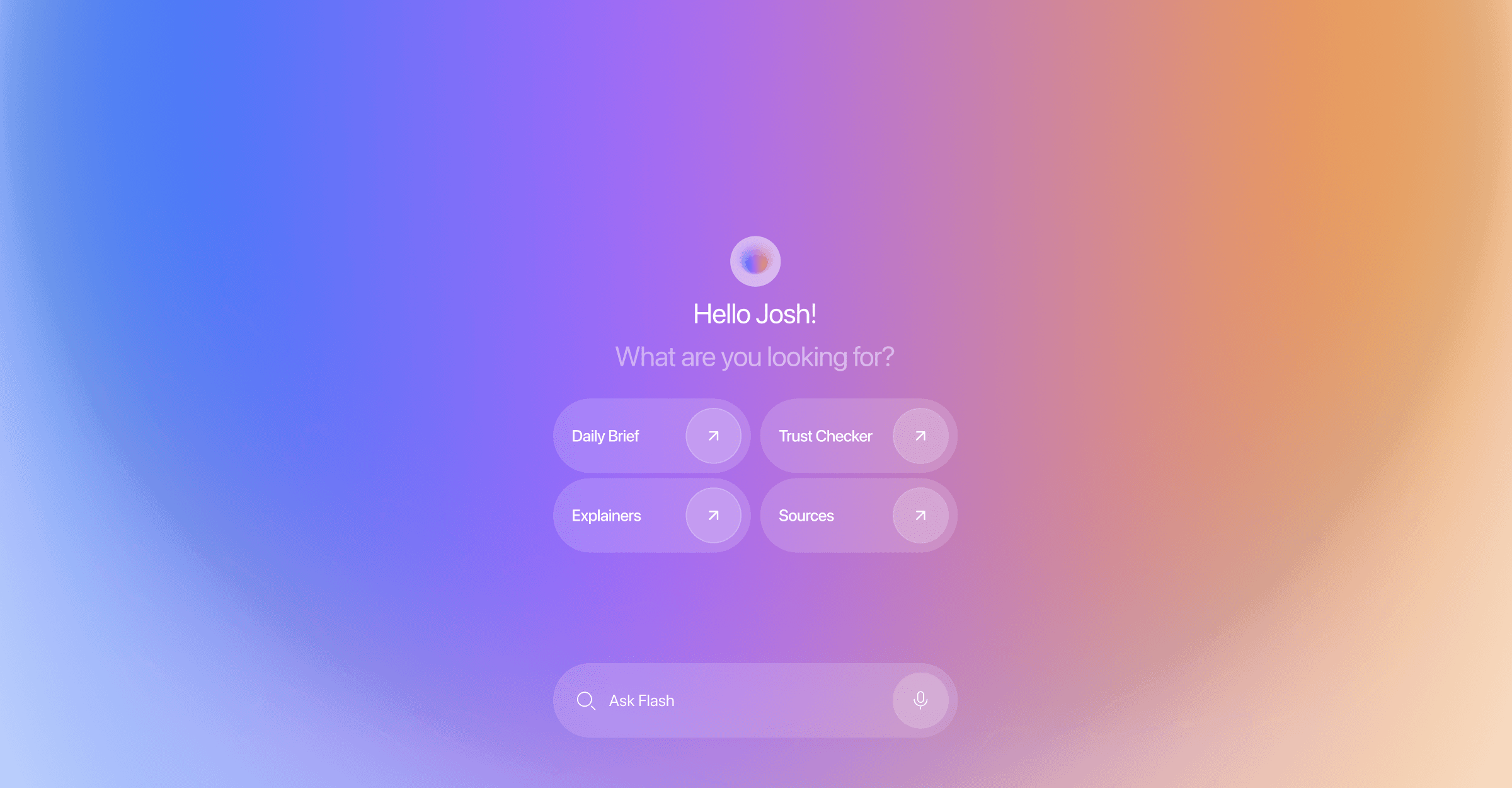
Flash AI is positioned as a tool for speed and clarity:
What I would measure (success metrics for an MVP)
What I shipped
Limitations

Reach Out
I document my learnings once a month. I would love to share them with you over mail. No bullshit. No spam. Straight up value.