Alphathena - Revamping an AI-enabled direct indexing platform with a faster transition flow and a clearer single account view
Product Strategy
UX Research Synthesis
Interaction Design
What is Alphathena?
Alphathena is an AI-enabled direct indexing platform built for RIAs and advisors, designed to make personalized indexing, tax optimization, rebalancing, and transition analysis easier to deliver at scale.
What is worked on
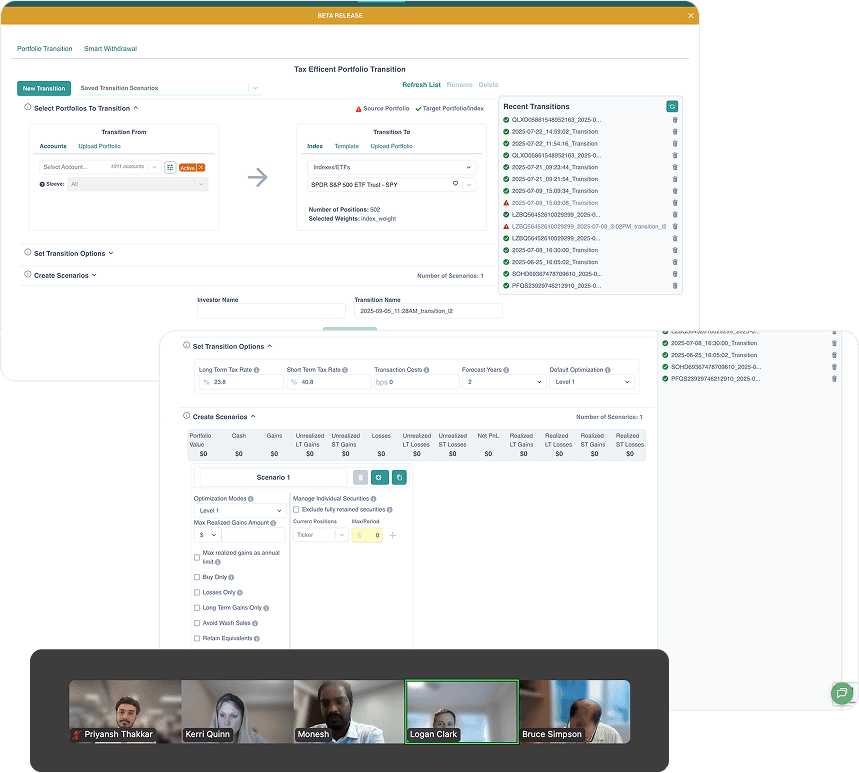
I led an end-to-end redesign across the marketing website and key in-product experiences, focusing on two high-impact areas: portfolio transition workflows and the single account view.
Role
Product Designer (end to end)
Duration
4 Weeks
Product and users
Direct indexing platform (B2B2C)
Users: advisors (B2B), ops and compliance (internal), end clients (B2C)
Design is workflow-heavy and data-dense, with sensitive financial data
Scope (4-week sprint)
Advisors use Alphathena to handle complex portfolio decisions under time pressure.
Things to-do
Transition flow to move users into the new product surface
Single account view for faster daily decision-making
Website refresh to clarify value and reduce bounce
Week 1
Scope
Research
customer journey
Week 2
user-flows
wire-framing - Lo-fi
sitemap
Week 3
interactive prototype
Specs
QA
Week 4
adjustments
Iterations
Success criteria
Quick Summary : Measuring success?
Speed-to-value: show useful insights before asking for deep setup
Reduce friction: fewer steps, fewer errors, fewer support tickets
Trust: privacy-safe defaults, clear consent, transparent data use
Dev-ready delivery: specs, states, QA, and ticket handling
Problem Statement
Advisors use Alphathena to handle complex portfolio decisions under time pressure.
The platform has to feel:
Trustworthy: clear explanations, visible assumptions, no black-box recommendations
Fast: fewer steps to run transitions and understand outcomes
Operational: details are dense (tax impact, concentration, constraints), but must remain usable
The biggest UX risk was not “lack of features.”
It was cognitive load and workflow friction in critical advisor moments.
User Research & Discovery
Where complexity turns into decision clarity (trust-first, advisor-grade)
Direct indexing decisions happen under time pressure and high consequence. Advisors need to explain recommendations, defend assumptions, and move from “what if” to “I can confidently act” without getting lost in dense tax, drift, and constraint details.
Research goals :
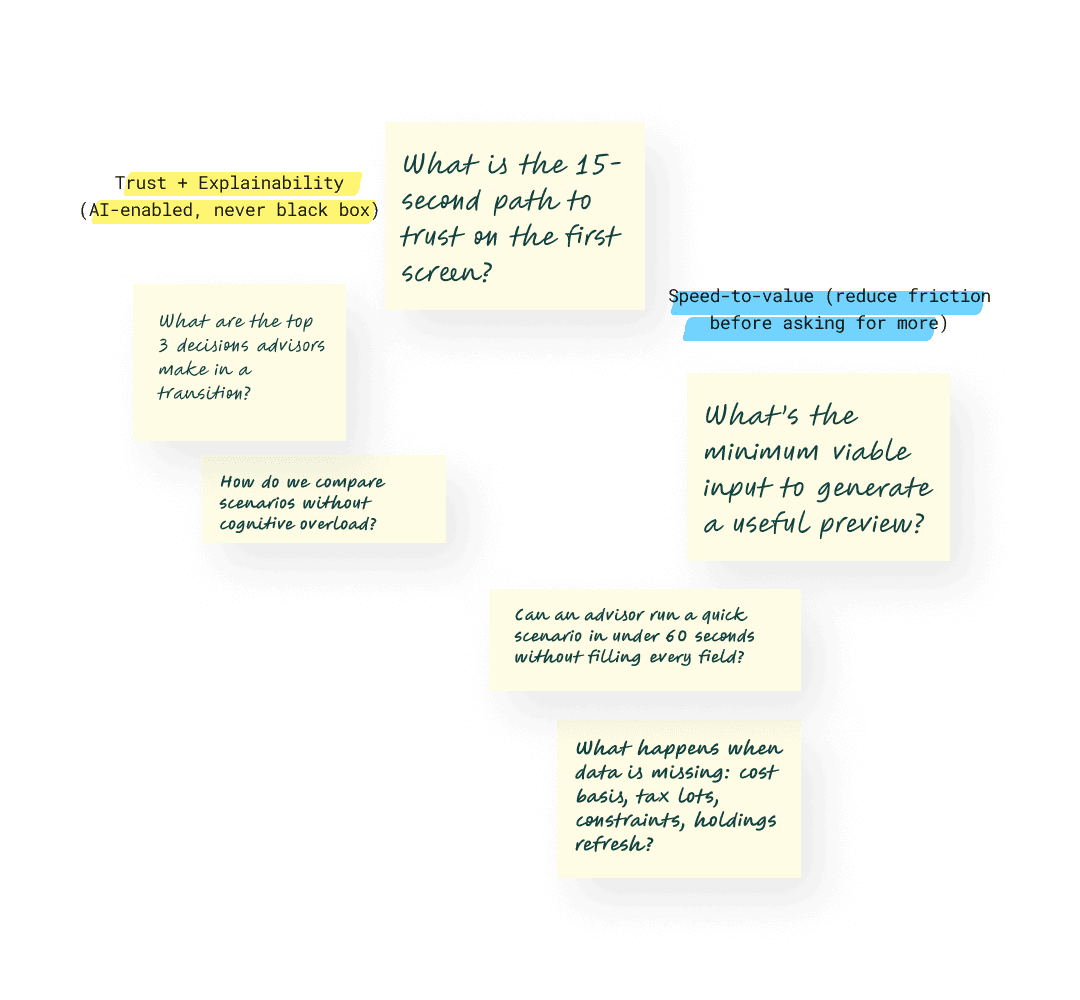
Identify where advisors lose confidence (black-box moments, unclear assumptions, hard-to-compare scenarios).
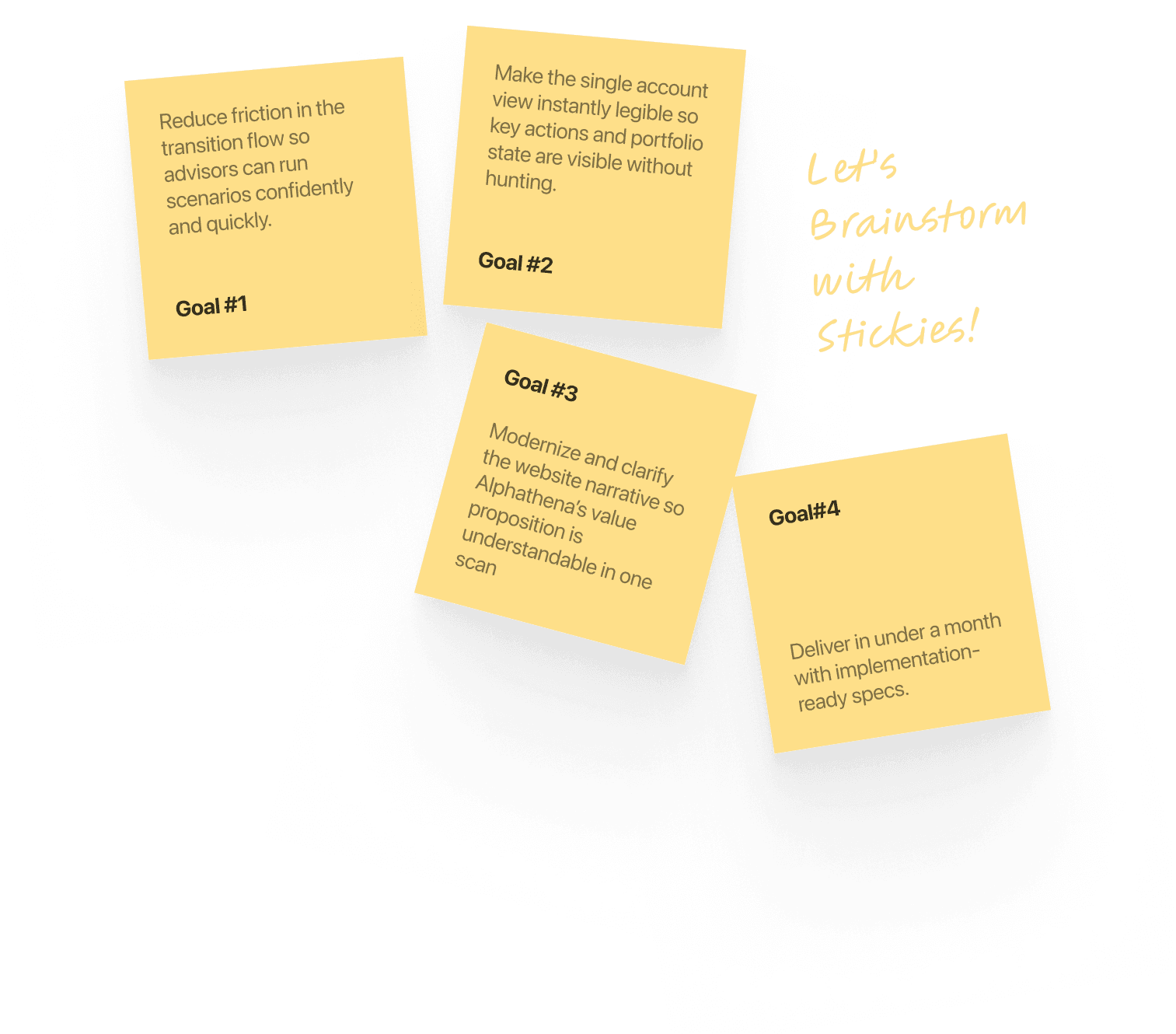
Reduce time-to-decision across the transition workflow (from upload to decision-ready summary).
Make the single account view instantly like an extension to transition view legible (what matters now, what changed, what action next).
Method 1: Stakeholder + SME interviews (RIA ops, portfolio specialists, PM, engineering)
What I did
Ran structured interviews to map the full “advisor reality”: transition planning, tax implications, constraints, approvals, exports, and what gets shown to clients.
Captured engineering constraints early (data availability, calculation timing, export templates, system limitations).
Aligned on “non-negotiables”: compliance sensitivity, explainability needs, and what outputs must be client-presentable.
What we learned
Advisors do not avoid complexity, they avoid uncertainty (black-box recommendations and hidden assumptions).
“Export” is a commitment moment: people only export when they feel the output is defendable.
The most expensive errors happen when constraints/tax assumptions are misunderstood or applied too late.
Method 2: Analytics review (drop-offs, export usage, scenario compare usage)
What I did
Reviewed funnel points: where users start transitions, where they abandon, and which actions correlate with completion (compare, export, adjust constraints).
Identified “hesitation zones”: repeated back navigation, long dwell times, low export rates after results view.
What we learned
Drop-offs cluster around two moments:
After upload / before results (uncertainty about what happens next)
Before export (lack of confidence in assumptions + outcomes)
Tool Stack Used




Used Amplitude + Looker to identify drop-offs, time-to-decision, and high-friction steps, then turned those findings into a prioritized optimization plan.
Captured the instrumentation plan in Notion and shipped it via Jira tickets with clear acceptance criteria tied to specific screens, states etc
Financial Advisor : “I do not mind complexity, I mind uncertainty.”
Opaque assumptions
“Where did this recommendation come from?” moments stop exports.
High cognitive load
Dense outputs force advisors to hunt for what matters first.
Hard scenario comparison
Inputs, outputs, and deltas are not standardized, so decisions slow down.
Risk of sharing too early
Advisors hesitate to show clients results that feel unfinished or hard to defend.


“I need to explain this recommendation to a client, not just believe it.”
Meet George!
Senior Financial Advisor at a mid-size RIA
Context
Manages 120+ client portfolios. Uses Alphathena to analyze holdings, test tax-aware transitions, and generate reports for client meetings.
What George Faces
Does not trust black-box recommendations
Afraid of making irreversible changes
Hard to compare multiple portfolio options
Client meetings are time-pressured
What It Means
Needs to understand why a scenario is suggested before acting
Needs safe what-if testing before committing
Needs to show clients “Option A vs B” clearly
Needs fast, decision-ready summaries
Discovery
Goals
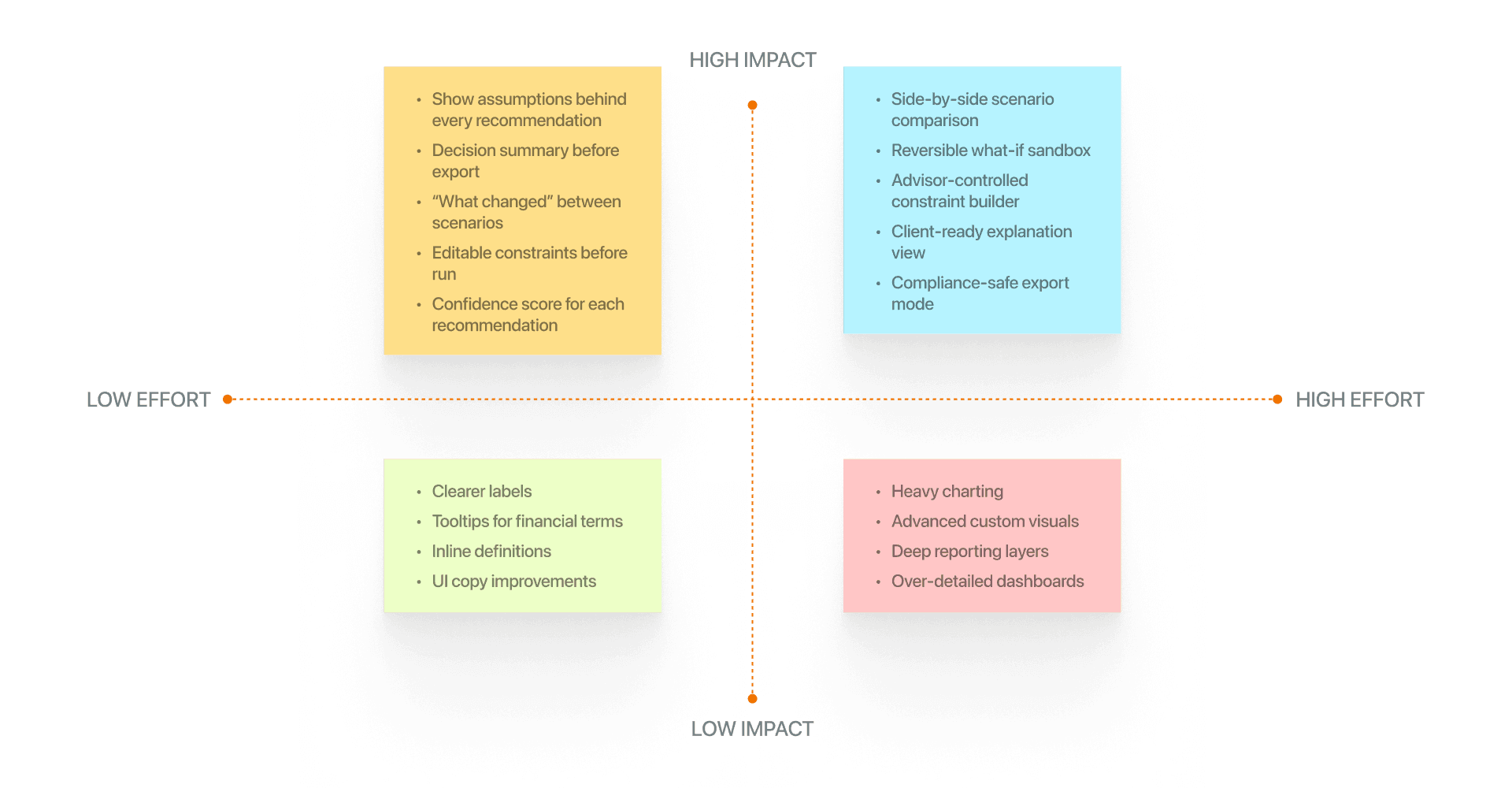
Trust-first UX patterns I introduced
AI never feels like a black box
Explain the “why” behind every recommendation
Show the inputs and logic used (constraints, holdings, objectives) so advisors can validate the suggestion quickly.
Put the advisor in control with guardrails
Make every output safe to act on: simulate first, approve when confident, revert if needed, and export for client conversations and compliance.
Keep the UI calm, with depth on demand
Default to a simple decision-ready summary, then progressively reveal details (assumptions, lots, methodology) only when the advisor needs them.
My approach (full-stack)
From requirements to specs to post-launch iteration, AI-first but human-owned
Lifecycle (what I did in under 4 weeks)
Workflow-first UX audit
Mapped the advisor journey end-to-end.
Tagged friction by severity: high cost, high risk, high confusion.
Output: prioritized backlog with annotated screenshots and quick wins.
IA reset for decision sequence
Re-ordered screens by how advisors decide: what matters, what changed, what it costs, what to do next.
Moved deep detail behind progressive disclosure.
Standardized tables, filters, and states for consistency.
Trust patterns for AI
Explainability UI: why, inputs used, assumptions, guardrails.
User control: simulate, approve, revert, export.
Accessibility baseline: readable charts, focus states, error clarity.
Transition workflow: from black box to decision confidence
How we reduced risk, cognitive load, and time-to-decision in portfolio transitions
Current Flow (Before) : Opaque, risky, and hard to explain
Upload holdings
Black-box analysis
Dense output tables
Export without context
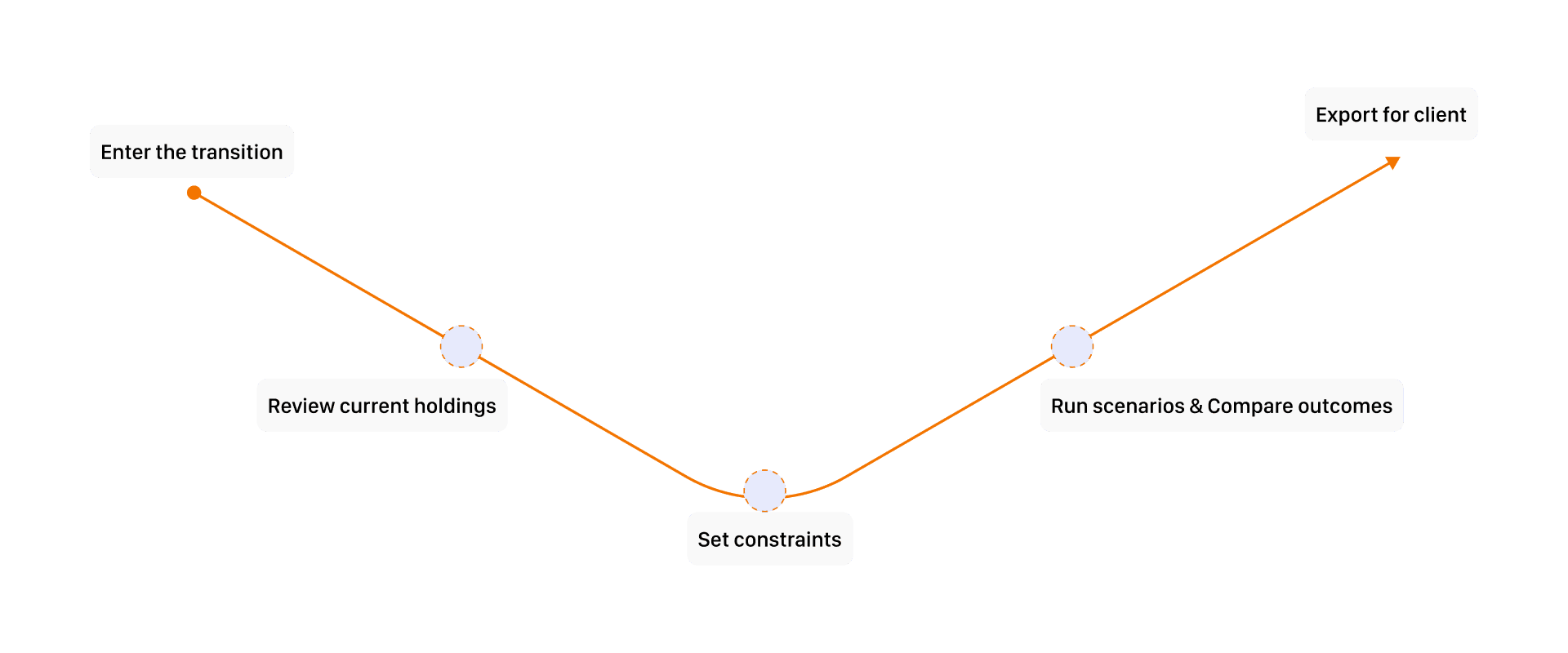
Proposed Flow (After)
Review holdings
Set constraints & preferences
Build scenarios
Compare outcomes
Decision summary & export

Reach Out
I document my learnings once a month. I would love to share them with you over mail. No bullshit. No spam. Straight up value.